
When the People Who Keep Cities Running Can't Afford to Live in Them
TORONTO, ON / ACCESS Newswire / April 1, 2026 / Across Canada's largest urban centres, a quiet crisis is deepening. Registered nurses are commuting two hours each way from distant suburbs to reach the hospitals where they save lives. Firefighters who protect downtown cores can no longer afford to live within the cities they serve. Elementary school teachers rotate through costly short-term rentals, unable to put down roots in the communities where they teach Canada's next generation.

Toronto hospital campus - the frontline of Canada's essential worker housing crisis.
The essential worker housing crisis - once a fringe concern raised at municipal planning tables - has evolved into one of the most consequential failures of Canadian housing policy. And for developers, planners, and policymakers, it is a challenge that demands bold, creative solutions.
"We've spent years talking about housing affordability in the abstract," says Ladan Hosseinzadeh Sadeghi, President & CEO of Sky Property Group Inc. "But when the people who staff our hospitals, protect our streets, and educate our children cannot afford to live in the cities where they work, the consequences go far beyond housing statistics. We're talking about the structural integrity of urban life itself."
The Scope of the Problem
The numbers are stark. In Toronto, the average rent for a one-bedroom apartment now exceeds $2,400 per month, while the median salary for a registered nurse hovers around $75,000 annually - leaving little room for even modest rental housing near major hospital campuses. In Vancouver, a firefighter earning $90,000 a year would need to spend more than 40 percent of their gross income to rent a two-bedroom apartment near their station. In Calgary and Ottawa, similar patterns are emerging as housing costs outpace public sector wages.
The result is a widening geographic gap between where essential workers are employed and where they can afford to live. This so-called 'labour catchment collapse' forces municipalities to compete for staff across increasingly wide geographic footprints, drives up operational costs through overtime and recruitment, and - in the case of emergency services - can meaningfully affect response times and service quality.
"This isn't just a social equity issue - it's an economic efficiency issue," says Hosseinzadeh Sadeghi. "Cities that cannot house their own workforce become operationally fragile. We saw that during the pandemic, when healthcare workers were driving ninety minutes each way to reach facilities that desperately needed them. That is not a sustainable model."

New workforce housing developments near employment nodes are gaining traction in Canadian cities.
Why Traditional Market Solutions Fall Short
The conventional assumption that market forces will eventually solve housing affordability has been tested and found wanting. In high-demand urban centres, the economics of new construction consistently favour luxury or premium mid-market units - the price points at which developers can recover escalating land, construction, and financing costs.
For essential workers - who typically earn stable but modest incomes - this market logic leaves a persistent gap. They earn too much to qualify for deeply subsidized affordable housing programs, yet too little to compete in the open market for appropriately located units. This 'missing middle' of housing affordability is not new, but the essential worker dimension gives it a sharper, more politically urgent edge.
Hosseinzadeh Sadeghi argues that the solution lies in targeted public-private partnership frameworks - models that use government-owned land, favourable financing, and density bonusing to unlock workforce housing that pencils out for developers while remaining genuinely accessible to essential workers.
"The financing tools exist. The land exists - hospitals, school boards, and municipalities are sitting on parcels that could be developed with the right partnership structures," she explains. "What's been missing is the political will to designate essential worker housing as a distinct priority category, with its own policy levers and incentive frameworks."

Ladan Hosseinzadeh Sadeghi, President & CEO of Sky Property Group Inc., advocates for targeted workforce housing policy.
Emerging Policy Approaches
Encouragingly, several Canadian jurisdictions are beginning to act. Ontario's Bill 185 opened the door to increased density near employment-intensive nodes, while some municipalities are piloting employer-assisted housing programs in partnership with major institutions like hospital networks and school boards. The federal Housing Accelerator Fund has also begun acknowledging workforce housing as a qualifying priority, unlocking additional grant funding for municipalities willing to streamline approvals for eligible projects.
In British Columbia, the province's new density zoning reforms allow for higher residential density within prescribed distances of major employment centres - a provision that, while broadly targeted, has particular benefit for essential worker populations concentrated near institutional campuses.
"What gives me optimism," says Hosseinzadeh Sadeghi, "is that we're seeing a growing convergence between employers and housing developers. Major healthcare networks are increasingly open to being anchor partners in workforce housing projects - providing land, supporting financing, or committing to long-term lease arrangements that de-risk the development. That kind of institutional partnership changes the math entirely."
A Development Community Responsibility
For Canada's real estate development sector, the essential worker housing crisis represents both a challenge and an opportunity. Developers who engage thoughtfully with municipalities on workforce housing projects can access streamlined approvals, reduced development charges, and access to federal and provincial funding programs - while contributing to the kind of complete, economically diverse communities that sustain long-term property values.
Sky Property Group has been actively engaged in advocacy for stronger inclusionary frameworks that carve out genuine workforce housing components in new major developments - not merely token affordable units tucked into otherwise luxury towers, but purpose-designed, well-located housing with deep ties to the employment anchors that generate demand.
"Developers have a role to play beyond simply responding to market signals," Hosseinzadeh Sadeghi asserts. "The most enduring communities - the ones that generate pride, stability, and long-term value - are the ones that house a full cross-section of the people who make urban life function. Nurses. Teachers. Paramedics. Transit operators. These are the people who give a city its character and its resilience."
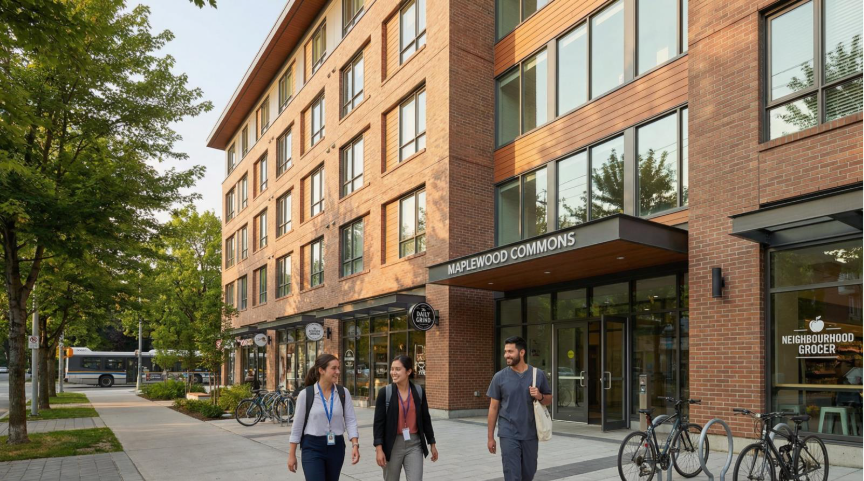
Purpose-built rental housing near employment centres offers a model for addressing the workforce housing gap.
The Path Forward
Addressing Canada's essential worker housing crisis will require coordinated action across federal, provincial, and municipal orders of government - combined with genuine engagement from institutional employers and the private development sector. Key priorities include:
Dedicated land pipeline: Unlocking publicly and institutionally held land adjacent to major employment nodes for essential worker housing
Targeted financing tools: Expanding Canada Mortgage and Housing Corporation programs specifically designed for workforce housing income brackets
Employer-assisted housing programs: Incentivizing large institutional employers - hospitals, universities, municipalities - to become active housing partners
Streamlined approvals: Fast-tracking planning approvals for projects that meet verified essential worker housing criteria
"The conversation in Canada needs to shift from 'affordable housing' as a monolithic concept to a more nuanced understanding of who we're actually trying to house - and what it takes to make those projects viable," says Hosseinzadeh Sadeghi. "Essential workers are not a charity case. They are the economic and social bedrock of every Canadian city. It's time our housing policy started treating them that way."
About Ladan Hosseinzadeh Sadeghi
Ladan Hosseinzadeh Sadeghi is President & CEO of Sky Property Group Inc., a Toronto-based real estate development firm focused on strategic land assembly and high-density residential development across the Greater Toronto Area. She is a recognized voice on Canadian housing policy, urban intensification, and sustainable development. For media inquiries, contact Sky Property Group Inc.
Media Contact:
Ladan Hosseinzadeh Sadeghi
ladanhosseinzadehsadeghi@gmail.com
SOURCE: Sky Property Group Inc.
View the original press release on ACCESS Newswire